

A model for creating a stronger, more equitable, and prosperous St. Louis—once and for all
 Once and for All is an effort to address the root source of our region’s longstanding challenges—from failing schools to high crime rates, slow economic growth, and our region’s steady decline in prosperity as well as national prominence and influence.
A wealth of research published by Washington University, University of Missouri–St. Louis, Forward Through Ferguson, Greater St. Louis Inc., and others shows how our high concentrations of poverty and communities in decline don’t just harm those most directly impacted. The effects of these conditions have a detrimental impact on our entire region.
All of this is why, in order for the St. Louis region to be competitive and successful in the years ahead, it’s vital that we invest in our under-resourced communities to address the source of our region’s challenges and create a stronger, more prosperous St. Louis—once and for all.
.embed-container { position: relative; padding-bottom: 45%; height: 0; overflow: hidden; max-width: 100%; } .embed-container iframe, .embed-container object, .embed-container embed { position: absolute; top: 0; left: 0; width: 100%; height: 100%; }
.embed-container { position: relative; padding-bottom: 45%; height: 0; overflow: hidden; max-width: 100%; } .embed-container iframe, .embed-container object, .embed-container embed { position: absolute; top: 0; left: 0; width: 100%; height: 100%; }
Who We Are
BEYOND HOUSING is a nationally recognized community development organization that works to strengthen families and transform underserved communities to create a stronger, more equitable, and prosperous St. Louis region for all. Our comprehensive model is built on the understanding that strengthening families and transforming underserved communities isn’t simple—it’s complex and requires a comprehensive, multi-pronged effort.Over the years, we have created the infrastructure of staff, partners, programs, and relationships that is essential for fulfilling our comprehensive model in order to create a stronger St. Louis—once and for all.
Our work brings civic leaders, targeted nonprofits, corporate partners, and residents together to create meaningful and lasting change and is focused within the 24:1 Community—a community comprised of multiple municipalities within the Normandy schools footprint in North St. Louis County.
In just over 10 years, Beyond Housing and its partners have raised and invested more than $150 million into the 24:1 Community.
A Model for Creating Meaningful and Lasting Change
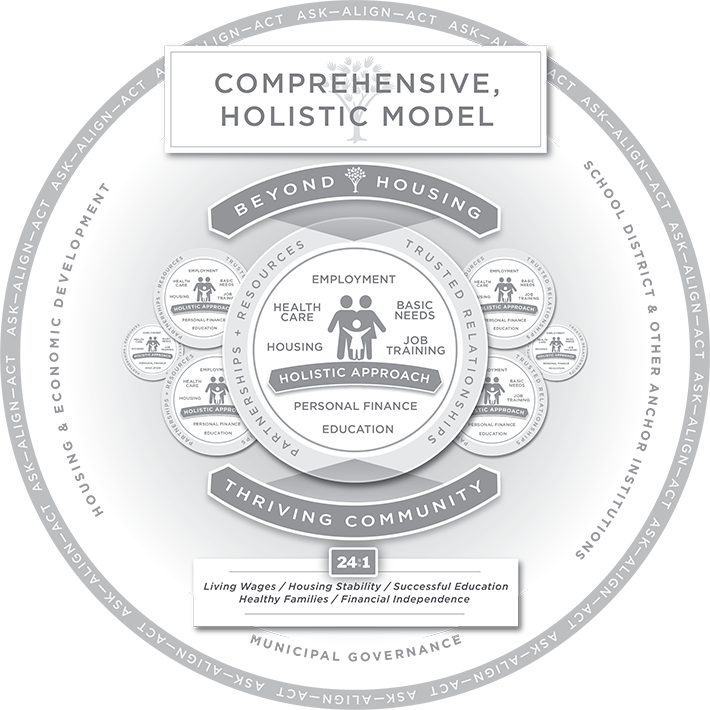
OUR COMPREHENSIVE MODEL for strengthening families and transforming underserved communities is based on our own experiences in community development over several decades, as well as learnings and data from national thought leaders including Washington University’s Health Equity Works, the Aspen Institute, Stanford Social Innovation Review, NeighborWorks America, U.S. Department of Housing and Urban Development, Federal Reserve Bank of San Francisco, Greater St. Louis Inc., and the Ferguson Commission.
This model is wholly unique in the field of community development and combines key insights on the realities of underserved communities and the efforts and resources that are needed for creating lasting change.
Its effectiveness has been proven by the results achieved over the last 10 years, as well as by the lack of meaningful results produced by other transformation efforts.
Comprehensive
Transforming underserved communities isn’t simple—it’s complex. Because of this complexity, real change cannot be achieved by addressing a single area such as housing or education on its own—it requires a comprehensive, multipronged effort. This is why so many single-focused efforts fail to produce any meaningful results.
Two recent examples of this are Facebook founder and CEO Mark Zuckerberg’s $100 million effort to improve schools in Newark, New Jersey and the Gates Foundation’s seven-year, nearly $1 billion initiative to improve education in several low-income communities. Despite generous funding and the best of intentions, both of these efforts failed to produce any meaningful results. We believe one of the primary reasons for this is a lack of understanding of how poverty impacts students and families—that what happens outside the classroom is even more of a factor as what happens within it.
Because of the breadth of challenges in underserved communities and their interdependent nature, our model is comprehensive and addresses entire communities by strengthening families, transforming the physical environment, and creating change at the systems level.

Holistic
Families and communities each have many needs that are interrelated and must be addressed as part of a greater whole.
Serving Families Holistically
People’s problems don’t exist in silos—they are interrelated. In order to help a parent earn a living wage we may also have to help them with transportation, childcare, or unmet health needs. Because of this, the following key impact areas necessary for thriving families are addressed in an integrated, holistic manner.
- Housing
- Health
- Education
- Employment
- Financial Advising
- Childcare
- Transportation
Serving Communities Holistically
Communities are ecosystems that require many things, each dependent on the other, in order to thrive. They have many needs—from an adequate stock of affordable housing to quality schools, sound infrastructure, convenient access to goods and services, effective local government, and more—in order to become successful places where people want to live.
- Transforming the Physical Environment
- Removing unsafe, dilapidated homes
- Constructing new and rehabbing existing homes
- Economic development to bring in new businesses, create jobs, and provide access to essential goods and services from food to financial and health services
- Improving municipal infrastructure from roads to sewers; city planning and beautification through parks, pedestrian walkways, and greenspaces
- Creating Change at the Systems Level
- Community Governance & Capacity Building: Partnering with municipal leaders and local government to create better financial efficiencies and quality of services to residents, while also coordinating municipal mergers, consolidation of courts, police departments, and other essential services
- Advocacy: Advocating for the needs of the community with local and state government
Deep, Trusted Relationships
Change moves at the speed of trust. Creating real change requires an understanding of the community along with building deep, trusted relationships with residents, government officials, the business community, and other community stakeholders.
Building these relationships takes time, but they are critical for building trust which is essential given the amount of mistrust that exists from decades of unfulfilled promises, systemic racism, and broken systems.
Ask, Align, Act
We continually initiate conversations with residents and the greater community to identify priorities. Our model of Ask, Align, Act ensures that our actions are guided by the voice of the community. We ask for the community’s input to identify priorities, and then work to align resources and act toward fulfilling a common vision.
Built for Complex Challenges
Having a comprehensive model in itself is not enough. Creating real change also requires significant resources as well as a system to deliver those resources in an integrated, holistic manner.
Infrastructure of Staff, Programs, Partners, and Resources
Delivering a truly comprehensive model requires more resources than any one organization can deliver on its own. This is why we have invested so heavily over the years to create an infrastructure of staff, programs, and nonprofit partners with complementary skills and expertise.
Beyond Housing Staff and Programs
Beyond Housing staff are an integral part of establishing close, trusted relationships with families in the community.
Each family is supported by staff members focused in specific areas: housing and supportive services which includes employment, childcare, financial advising, and other services; education, which ensures basic needs are met so children can succeed academically; and health, which includes addressing unmet health needs that can prevent families from becoming self-sufficient.
Programs Serving the Greater Community
Staff, partners, and programs also focus on the needs of the greater community. These include: economic development to create commercial development projects, support local small businesses, attract new businesses, and create jobs; working with municipal leaders to improve services, the efficiency of budgets, and facilitate infrastructure upgrades; youth development including after-school and summer programs and college saving programs; and more.
Staff work directly with a network of nonprofit organizations as well as corporate partners and anchor institutions including the Normandy Schools Collaborative, University of Missouri-St. Louis, and Washington University.
Making Every Dollar More Effective
The comprehensive, holistic nature of this model combined with the infrastructure of staff, programs, partners, and services provides collective impact—an impact that is far greater together than each individual effort on its own.
This also makes each dollar invested exponentially more effective. Investments toward education or health, for example, achieve greater results because of the mutually reinforcing work being done in other interrelated areas which creates lasting change for generations to come.
Additionally, our new logic model, created in partnership with Washington University, maps the logical relationships between resources invested and activities within our comprehensive model. This enables us to measure the benefits or changes that result from these investments in order to track and optimize our efforts to achieve greater results moving forward.
Resources for Achieving Scale
Our model has delivered impressive results over the last 10 years, and we expect to achieve even greater results in the years ahead.
Transforming underserved communities doesn’t happen overnight, but things can always change if enough people want them to.
We believe that a better St. Louis is within our reach. The St. Louis area has the heart, talent, and resources to reinvent ourselves for the better. By pooling more resources and expertise from a wider coalition of partners, we can address our underlying issues to make this home of ours what we want it to be—once and for all.
A Track Record of Proven Results (2010-2020)
The following is a highlight of results and achievements over the last decade. Though we believe these results are impressive, we have continually refined our model and approach throughout the years and are confident this model will produce even greater results in the years ahead.
-
$150,000,000+
raised and invested in the 24:1 Community since 2010 -
$70,000,000+
invested in construction projects for housing and economic development
Housing and Infrastructure
-
$48,000,000+
invested in affordable housing construction - $13,000,000+
provided in owner occupied home repair grants - $20,100,000
increase in property values - $35,000,000
invested in affordable housing construction -
200+
dilapidated homes demoed -
200
new affordable homes constructed -
509
affordable rental homes currently occupied -
$6,000,000+
invested in new streets, improved infrastructure, and beautification in 2019 alone
Commercial/Economic Development
-
GROCERY STORE, TWO SENIOR HOUSING CENTERS, MIDWEST BANK CENTRE, 24:1 CINEMA, AFFINIA HEALTHCARE CLINIC, BJC BEHAVIORAL HEALTH CLINIC, ANTI-PAYDAY LOAN CENTER, AND CREDIT UNION
- $6,500,000
second phase of our successful commercial and economic development in Pagedale with a new $6.5 million, 20,000-square-foot building opened in July of 2021, home to minority-owned businesses including restaurants, retail, office space, culinary training center, and brewpub - $35,100,000
in commercial development
Education
-
80%
of students and families engaged with Family Engagement Liaisons in 2019 remained in their homes -
65%
of student attendance maintained or improved in 2019 -
54% to 81%
growth in high school graduation rates from 2014 through 2017 -
97%
improvement in reading and math for children attending Pagedale Family Support Center -
93%
of high school seniors in Viking Advantage college savings program enrolled in college - 7.1% to 62.5%
increase in overall test performance from 2014 through 2017 - 2013-2017
period during which we assisted the Normandy school district in regaining accreditation - $970,252
total college savings used toward post-secondary education since inception of the College Savings Program -
2019
Horace Mann Friend of Education Award from Missouri National Education Association -
2019
Family Engagement Liaisons Program named a Merit Finalist in Mutual of America Community Partnership Awards
Personal Finance/Wealth Creation
- $14,500,000
in wealth creation (individual savings accounts, college savings, and down payment assistance for new homeowners) -
51%
reduction in number of families being evicted or moving due to financial problems since inception of Housing Resource Coordinators (HRCs) -
65%
of people served reporting increase in family income in 2019 -
76%
improved their self-sufficiency in 2019 -
19
move outs in 2018 due to families becoming first-time homeowners -
2%
annual increase in assessed property values
Health
-
Community Health Workers (CHWs)
established in 2019 to help meet unmet health needs with a focus on chronic conditions of type 2 diabetes and childhood asthma -
Improved access
to healthcare with the opening of Affinia Healthcare and BJC Behavioral Health clinics in 2019 -
92%
of participants in Community Health Program completed all primary and preventative care appointments -
82%
of participants in Community Health Program did not visit an emergency room for primary care -
1st
New Save a Lot grocery store—the first grocery store in Pagedale in 40 years—opened in 2010 providing access to fresh, healthy food in what was previously a food desert -
2016
winner of Robert Wood Johnson Foundation Culture of Health prize
Government
-
17
local governments collaborating and saving over $1 million on public services -
13
court systems consolidated into two main court hubs to create savings and improved services -
13
police departments consolidated into two police forces -
1st
municipal merger in the history of St. Louis County, merging Vinita Park into Vinita Terrace; a second merger is underway with the Village of Glen Echo Park and the City of Normandy